Pokélog ENG


Introduction
Pokélog is a system developed to record detailed information about the Pokémon encountered by trainers, serving as a living book of knowledge that expands as trainers interact with different species throughout their journey. Its progression occurs through actual battles in hunting locations, recording abilities, behaviors, and fighting patterns based on the practical experience of trainers.
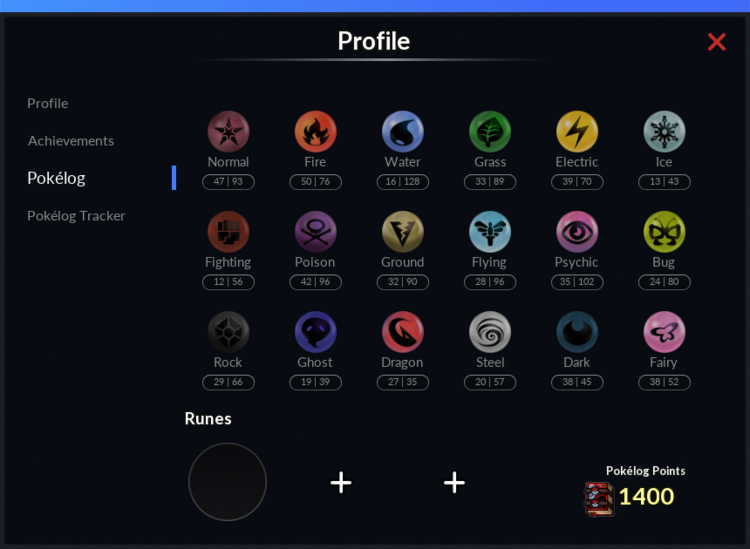
The interface is located under the player's profile, via the default shortcut P. All creatures are classified according to their element.
How it works
The record is automatically made when defeating any Pokémon. Upon completion, the player will be notified that they have reached the goal of defeating Pokémon of that type and can claim their reward.
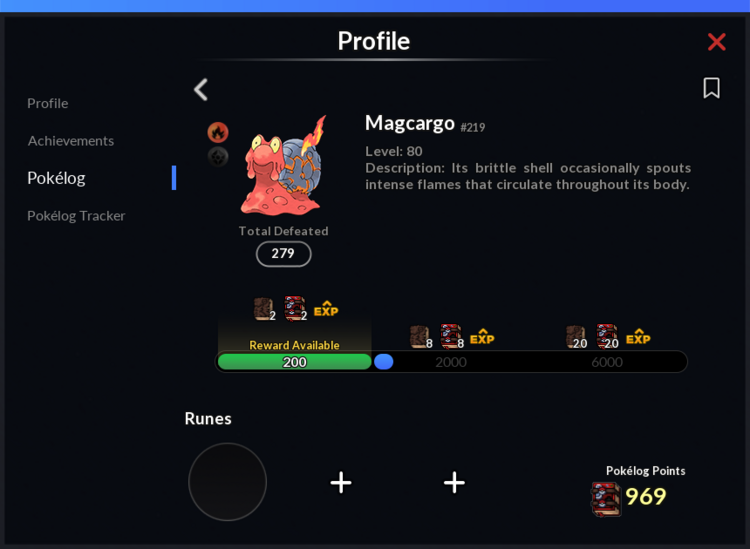
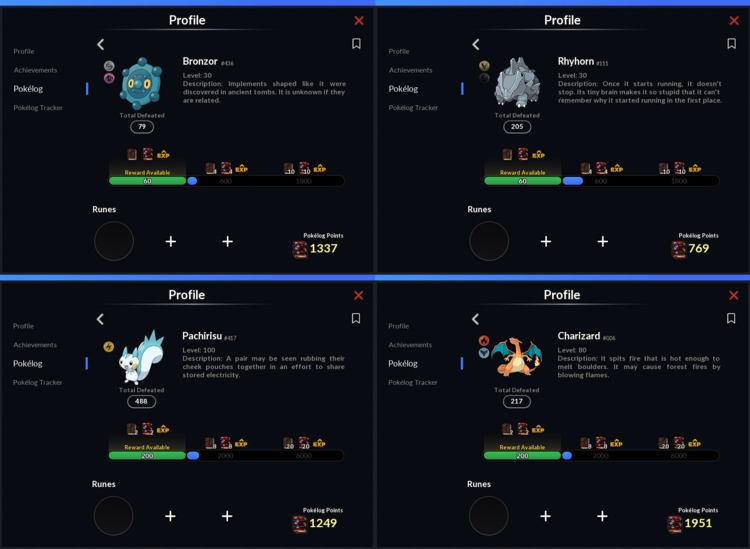
Within the same category, such as level 40 Pokémon, the amount needed to complete each Pokélog will be similar (with rare exceptions). However, it is natural that the difficulty will vary between them, as some are more common and others are rarer in terms of distribution across the map. For example, completing the Pokélog for a Bronzor may take much longer than that for a Rhyhorn, just as a Pachirisu tends to be harder to find than a Charizard.
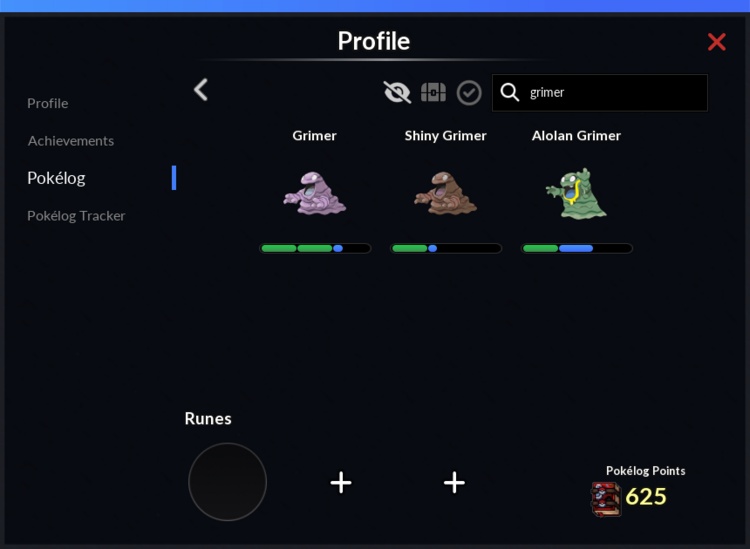
Pokélog considers all “Pokémon variations” as valid entries for the same Pokémon. Let's take Pidgeot as an example. If a trainer is interested in completing the Pokélog for Pidgeot, Pidgeot found in Kanto, Outland (Brave Pidgeot), Nightmare (Nightmare Pidgeot or T1H Pidgeot) will be counted within the “Pidgeot” category. Regarding regional forms, which are in fact different Pokémon, each has its own specific count; so in the case of Grimer, it has its own category while Alolan Grimer is in another, and each Pokémon counts only for its own category.
Attention: Only Pokémon found in the open world or hunting grounds will be counted in the Pokélog; those found exclusively in special content (DZs, Rifts, etc.) or Pokémon belonging to enemy trainers are not included in the system. In addition, Pokémon considered rare (such as Mamoswine) and Shinies are also cataloged, although there are some exceptions, such as Elder Pokémon (Shiny from Outland), which are not counted.
Rewards
Each cataloged Pokémon has three stages of progress, which reward players with Experience, Research Notes, and Pokélog Points. Some Pokémon, such as Shinies or other variations, may not provide Experience rewards during the stages of progress.
The Pokélog is a more dynamic and varied form of progression, similar to the daily catch system. Completing Pokélog stages grants experience, serving as a complementary alternative to traditional tasks. Upon completing a given Pokélog stage, your reward can be redeemed once. Most stages grant experience upon completion. The first stage is quicker to complete, while subsequent stages require more effort but offer additional rewards beyond experience.
Pokélog Research Notes
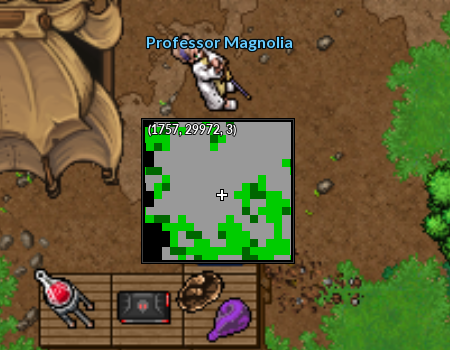
 Pokélog Research Notes are records made during field research conducted when defeating Pokémon. Upon obtaining a certain amount of Pokélog Research Notes, the player will be able to exchange this item for items that will contribute to their progress in the game; however, there is a limit to the number of exchanges that can be made. In addition, it is also possible to acquire some cosmetics. To unlock the exchange interface, the player must speak to the NPC Professor Magnolia in the Lost Ruins in Johto. She will ask for 50 Pokélog Research Notes so that she can study your achievements.
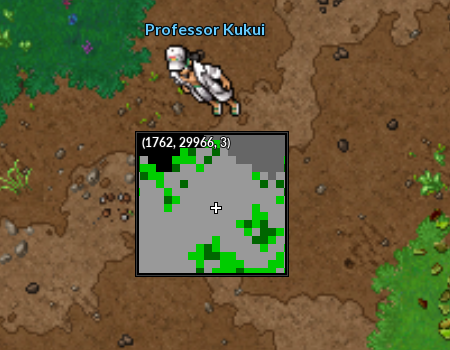
Afterwards, the player should talk to the NPC Kukui, located on the same island. He is responsible for exchanging Pokélog Research Notes for consumable and cosmetic items.
In the table below, players can check out all the crafting possibilities.
| Item | Craft Time | Number of Available Crafts | Requirement | ||
|---|---|---|---|---|---|

|
Premier Ball | 1 second | 200 | 
|
10 Pokélog Research Notes |

|
Profession Booster | 1 second | 6 |
|
75 Pokélog Research Notes |

|
Minor XP Boost | 1 second | 6 |
|
50 Pokélog Research Notes |

|
Energy Drink | 1 second | 4 |
|
100 Pokélog Research Notes |

|
Pokélog Booster | 1 second | 6 |
|
100 Pokélog Research Notes |

|
Pokélog Catcher Totem | 1 second | 10 |
|
50 Pokélog Research Notes |

|
Pokélog Charm Totem | 1 second | 6 |
|
100 Pokélog Research Notes |

|
Bestial Marowak Avatar Card | 1 second | 1 |
|
500 Pokélog Research Notes |
|
|
Bestial Marowak Avatar Card | 1 second | 1 |
|
500 Pokélog Research Notes |

|
Bestial Marowak Costume | 1 second | 1 |
|
3000 Pokélog Research Notes |
Pokélog Points
 Pokélog Points are virtual rewards earned by cataloging Pokémon. They can be used to unlock Legendary Runes, which have connections to legendary Pokémon and their powers.
Notes:
- Unlocked Legendary Runes are permanent for the character and can be activated as needed by the player.
- Trainers are free to accumulate and spend Pokélog Points as they wish.
- After spending Pokélog Points and unlocking a Legendary Rune, there is no way to “undo the action” (it will not be possible to recover the Pokélog Points spent to choose another Legendary Rune).
Legendary Runes
Legendary Runes are ancient enigmas that contain hidden powers capable of interacting with spiritual and legendary Pokémon. These runes are scattered across the remote island of Lost Ruins in the Johto region. There is evidence that an ancient civilization venerated legendary Pokémon and inscribed formulas on these monoliths to channel their power. These inscriptions are directly linked to legendary Pokémon such as Darkrai, Zacian, Celebi, Victini, Zamazenta, Moltres, Mewtwo, Articuno, Zapdos, Ho-oh, Lugia, and Mew. Each represents aspects such as time, light, protection, conflict, and other fundamental elements of the Pokémon world.
Unlocking Legendary Runes
Once unlocked, these runes will grant the trainer certain bonuses upon completing Pokélog stages. To unlock them, players will need to spend Pokélog Points, and to activate them, they will need to complete a certain number of Pokélogs of the desired element. Trainers will have up to three slots to use Runes simultaneously. Initially, everyone starts with only one slot enabled and can purchase expansions to unlock additional slots if they prefer. In terms of the benefits offered, Runes act based on the element inserted into them. That is, after enabling a Rune, the player will need to choose an element before activating it, and the bonus will only be enabled in the selected element until the trainer removes the rune/element from the space and activates it again. The following Runes are available:
| Rune | Bonus Applied | Requirement | ||
|---|---|---|---|---|

|
Flamewing | Your Pokémon has a 5% chance of activating an elemental attack against enemies of the chosen element. Does not work in the Nightmare World. | 
|
1000 Pokélog Points |

|
Tempest | Your Pokémon attacked by a Pokémon of the corresponding element will gain 30 MS for 20 seconds. |
|
800 Pokélog Points |

|
Victory | The trainer will receive a 5% catch bonus against Pokémon of the chosen element. |
|
2000 Pokélog Points |

|
Powerful | The trainer will gain a 5% experience bonus against Pokémon of the chosen element. |
|
2000 Pokélog Points |

|
Unscathed | Your Pokémon has a 50% chance of not receiving negative effects from the Pokémon of the chosen element. This bonus stacks with your Pokémon's bonus. |
|
1100 Pokélog Points |

|
Guardian | Your Pokémon has a 5% chance of blocking attacks from a Pokémon of the chosen element. |
|
2400 Pokélog Points |

|
Heroic | Your Pokémon has a 5% chance of landing a critical hit on a Pokémon of the chosen element. |
|
2400 Pokélog Points |

|
Frozen | Your Pokémon will reduce the movement speed of Pokémon of the chosen element by 50 MS for 20 seconds. |
|
900 Pokélog Points |

|
Sacred | Your Pokémon will receive a 5% bonus in loot for Pokémon of the chosen element. |
|
2300 Pokélog Points |

|
Ocean | Your character will become 10% more resistant to the chosen element. |
|
1200 Pokélog Points |

|
Nightmare | Your Pokémon has a 5% chance of applying the Blind effect for 6 seconds with its attacks against Pokémon of the chosen element. |
|
1400 Pokélog Points |

|
Celestial | You will have a 30% higher chance of encountering shiny Pokémon of the corresponding element. |
|
2600 Pokélog Points |
Attention: When you unlock a rune, it will be permanently available to the character who unlocked it. You will then need to insert an element to activate its bonus.
Adding an Element to the Legendary Rune
To add an element to any rune, the trainer must complete a minimum number of Pokélogs in the respective category. To do so, simply complete 10 Pokémon entries for the corresponding element to unlock it. For example, the Pokélog for the Fire category is 10/100, Ice 5/100, Electric 28/100, and Flying 0/100. In this case, it would only be possible to assign the Fire or Electric elements to the Runes. To remove an active rune and select a new element to replace it, a fee is charged according to the player's level, as follows:
| Level | Cost |
|---|---|
| 0 to 149 | 10K |
| 150 to 249 | 50K |
| 250 to 399 | 200K |
| 400+ | 500K |